






 Zuhause
 Produkte
29+ years in pharmaceutical machinery, covering capsule filling, tablet pressing, blister packaging, tablet and capsule counting, cartoning, GMP production, and overseas machine service.

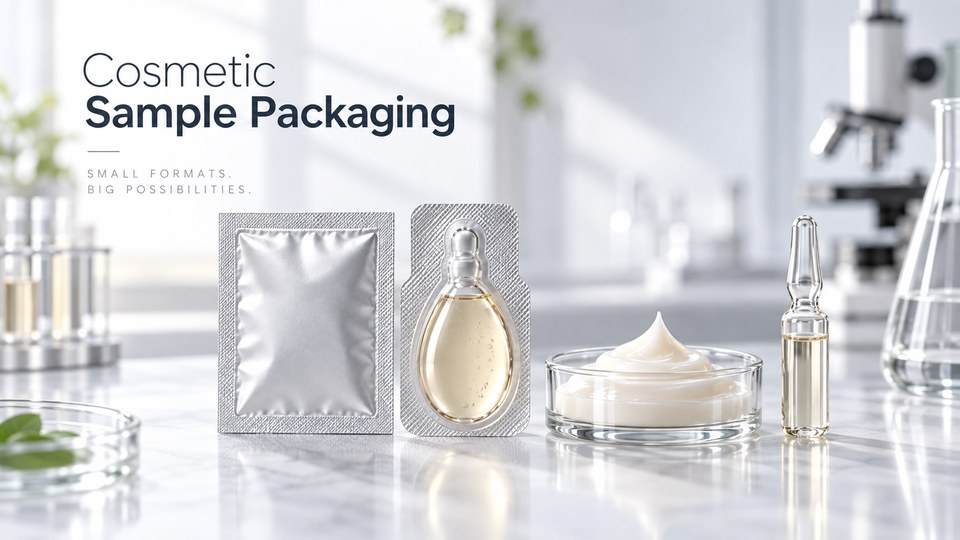
Die Verpackung für Kosmetikproben sollte basierend auf dem Verhalten der Formel, der Zieldosierung, dem Verwendungszweck, dem Materialschutz, der Abfüllmethode, den Anforderungen an Versiegelung oder Verschluss sowie den Produktionsbedingungen ausgewählt werden.Ein Serum, eine Essenz, eine Lotion, eine Creme, ein Gel, ein Öl oder ein Duftstoff kann in einem Sachet, einem Blister, einer Ampulle, einer Minitube oder einer Miniflasche verpackt werden, aber das beste Format ist dasjenige, das konsistent befüllt werden kann, die Formel schützt, sich wie vorgesehen öffnen lässt und im erforderlichen Maßstab zuverlässig verarbeitet werden kann.
Verwenden Sie diese Entscheidungssequenz:
Formel → Zieldosierung → Abfüllmethode → Verpackungsformat → Material und Versiegelung/Verschluss → Produktionsversuch
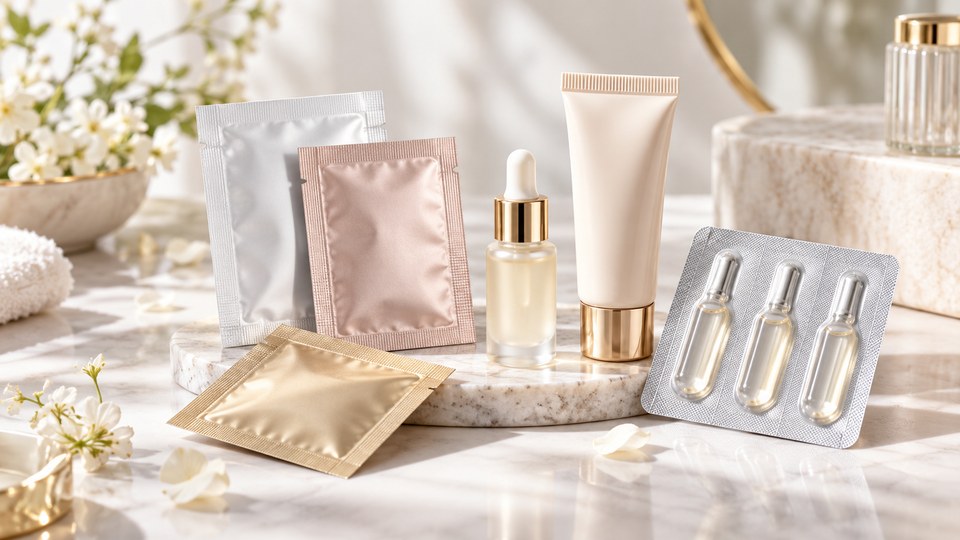
Die Hauptformate sind flexible Sachets, thermogeformte Flüssigkeitsblister, Ampullen, Minituben und Miniflaschen. Die Wahl verändert nicht nur das Kundenerlebnis, sondern auch das Abfüllsystem, die Materialstruktur, die Werkzeuge, die Versiegelungsmethode und den Umrüstaufwand.
|
Format |
Typische Rolle |
Verpackungsstruktur |
Produktionslogik |
Hauptauswahlkriterium |
|
Sachet / Probenbeutel |
Einweg- oder kleine Testprobe |
Flexible Folie oder mehrschichtige Struktur |
Formen und erste Versiegelung → Befüllen → Verschluss-Siegel → Schneiden |
Produktfluss, Folie, Siegelformat, Sauberkeit der Siegelzone |
|
Flüssigkeitsblister / Pod |
Definierte Einweg-Kavität |
Geformte Bahn + Deckelmaterial |
Formen → Befüllen → Heißsiegeln → Stanzen |
Kavitätsgeometrie, Abfüllsystem, Werkzeuge, Materialpaarung |
|
Ampulle |
Individueller kleiner Behälter |
Behälterbasiert |
Technologieabhängig |
Dosierung, Kompatibilität, Öffnen/Dosieren |
|
Minitube |
Kleine Mehrweg-Testprobe |
Zusammendrückbarer Behälter |
Technologieabhängig |
Produktfluss, Verschluss, Anzahl der Anwendungen |
|
Miniflasche |
Kleine Mehrweg-Testprobe |
Starrer Behälter + Verschluss |
Technologieabhängig |
Verschluss, Dosierung, wiederholte Verwendung |
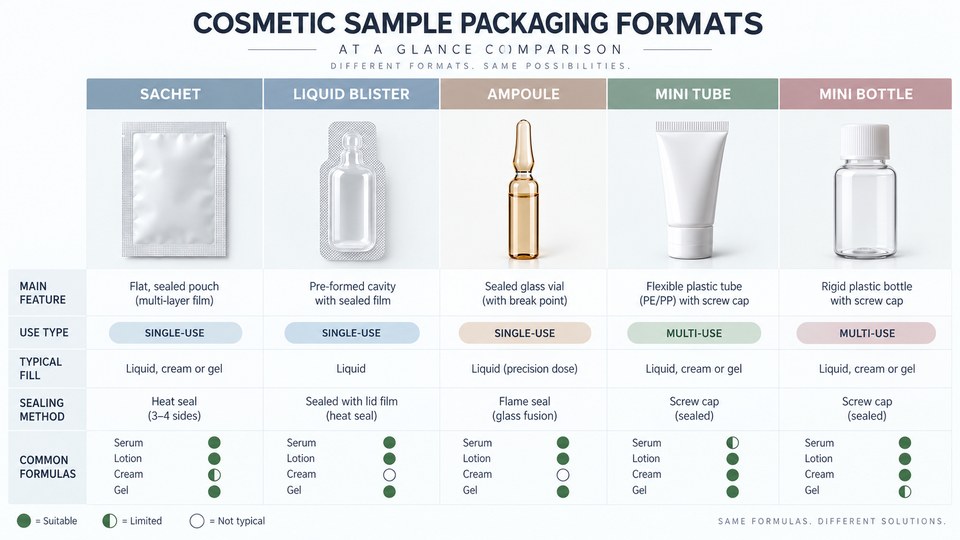
Ein Sachet für Kosmetikproben ist eine gute Wahl, wenn die Probe flach, leicht, kompakt zu verteilen und einfach zu bedrucken sein muss. Sachets können Flüssigkeiten, Cremes, Gele und Pasten verarbeiten, wenn das Abfüllsystem und die Folienstruktur auf das Produkt abgestimmt sind.
Die Folie kann eine einfache Struktur oder eine mehrschichtige Kombination sein, die Druck-, Festigkeits-, Barriere- und Heißsiegelfunktionen bietet. Drei-Seiten-Siegel-, Vier-Seiten-Siegel- und Rückseiten-Siegel-Sachets verwenden unterschiedliche Folienwege und Versiegelungsanordnungen, daher beeinflusst das Sachet-Design die erforderliche Maschineneinrichtung.
Für tiefergehende Anleitungen zu Sachet-Strukturen und Herstellung siehe Was ist ein Sachet? Ein vollständiger Leitfaden zur Sachet-Verpackung.
Wählen Sie einen Flüssigkeitsblister, wenn ein definierter dreidimensionaler Hohlraum einen funktionalen Vorteil gegenüber einer flachen Packung bietet. Ein Flüssigkeitsblistersystem trennt das Formen, Befüllen, Heißsiegeln und Stanzen in verbundene Stationen.
Hohlraumabmessungen beeinflussen die Werkzeuge und den verfügbaren Füllraum. Das Verhalten der Rezeptur beeinflusst die Füllkonfiguration. Form- und Deckelmaterialien bestimmen das Siegelfenster. Die endgültige Kontur bestimmt das Stanzwerkzeug.
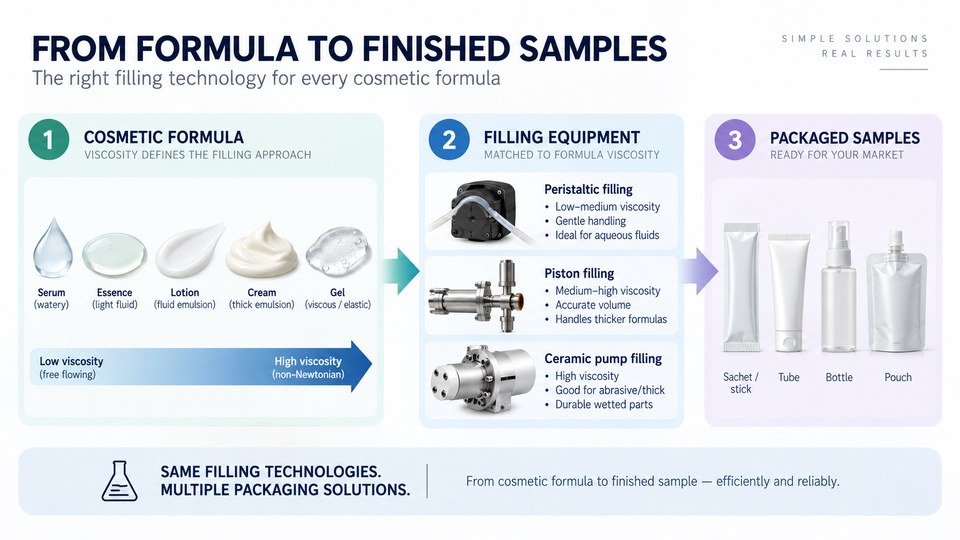
Anlagen für Flüssigkeitsblister können mit verschiedenen Dosiersystemen konfiguriert werden.Peristaltik-Befüllung ist eine praktische Option für gut fließende Flüssigkeiten, Kolbenbefüllung für viskosere Produkte und Keramikpumpen, wenn eine höhere Dosierpräzision erforderlich ist.Dies sind Ausgangskonfigurationen, keine universellen Regeln für Rezeptur-zu-Pumpe; die tatsächliche Rezeptur und die Zieldosis sollten die endgültige Wahl bestätigen.
Für eine tiefergehende Prozesserklärung siehe Flüssigkeitsblister-Verpackungsmaschine und wie Blisterverpackungsmaschinen Kosmetika verpacken.
Diese Formate sind am nützlichsten, wenn ein individueller Behälter, eine kontrollierte Abgabemethode oder mehrere Anwendungen wichtiger sind als die Effizienz von Flachpackungen.
Ihre detaillierten Produktionswege hängen von der spezifischen Behältertechnologie ab, daher sollten sie zuerst verglichen werden nach:
Dosis → Anzahl der Anwendungen → Kompatibilität → Barriereanforderungen → Abgabemethode → Produktionsvolumen
Beginnen Sie mit der Rezeptur und der Dosis und fragen Sie dann, was die Verpackung während des Befüllens, Siegelns, Vertriebs und Gebrauchs leisten muss.
|
Rezeptur |
Hauptfrage zur Verpackung |
Sachet |
Flüssigkeitsblister |
Andere Option |
|
Serum / Essenz |
Kann eine kleine Dosis dosiert und vom Siegelbereich ferngehalten werden? |
Starke Option |
Starke Option |
Ampulle oder Miniflasche |
|
Lotion / Emulsion |
Ist die Befüllung stabil und mit dem gewählten Material kompatibel? |
Starke Option |
Starke Option |
Minitube/Flasche |
|
Creme |
Kann der Füller eine höhere Viskosität sauber verarbeiten? |
Geeignet mit abgestimmter Befüllung |
Geeignet mit abgestimmter Befüllung |
Minitube |
|
Gel |
Können Abfüllung und Abschneiden kontrolliert bleiben? |
Geeignet bei abgestimmter Abfüllung |
Geeignet bei abgestimmter Abfüllung |
Tube/Behälter |
|
Öl / Duftstoff |
Sind Kompatibilität, Eindämmung und Dosierung geeignet? |
Projektabhängig |
Projektabhängig |
Miniflasche/Ampulle |
Vergleichen Sie bei Serum und Essenz Zieldosierung, Barrierebedarf, Materialkompatibilität, Öffnungsmethode, Anzahl der Anwendungen und Produktionsvolumen.
Ein Sachet begünstigt flache Verteilung und Druckfläche; ein Blister begünstigt einen definierten Hohlraum; ein Einzelbehälter begünstigt kontrollierte Dosierung oder wiederholte Verwendung.
Lotion, Creme und Gel erfordern, dass Abfüllmethode und Verpackungsgeometrie zusammenarbeiten. Produkte mit höherer Viskosität benötigen Abfüllsysteme, die die Zielmenge abgeben können, ohne dass übermäßig viel Produkt in den Siegelbereich gelangt.
Bei der Produktion von Flüssigblistern kann die Kolbenabfüllung ein praktischer Ausgangspunkt für viskosere Produkte sein. Wenn sich die Formelviskosität wesentlich mit der Temperatur ändert, kann eine temperaturgeregelte Produktzuführung helfen, den Fluss zu stabilisieren. Sie sollte nur innerhalb des zugelassenen Verarbeitungsbereichs der Formulierung verwendet werden und sollte kein ungeeignetes Abfüllsystem kompensieren.
Bei Öl- und Duftstoffprojekten sollte besonderes Augenmerk auf Materialkompatibilität, Eindämmung, Dosierkontrolle und Abgabe gelegt werden. Die Materialstruktur und Abfüllkonfiguration sollten mit der tatsächlichen Formel bestätigt und nicht allein anhand der Produktkategorie ausgewählt werden.
Nutzen Sie das Verpackungsformat, um die Projektanforderung zu lösen, nicht als visuelle Wahl, die vor der Prozessüberprüfung getroffen wurde.
|
Entscheidungsfaktor |
Sachet |
Flüssigblister |
Ampulle |
|
Flache, kompakte Verteilung |
Stark |
Begrenzt |
Begrenzt |
|
Definierter Hohlraum/Behälter |
Begrenzt |
Stark |
Stark |
|
Einweg-Probe |
Stark |
Stark |
Stark |
|
Bedruckbare Fläche |
Groß |
Mäßig |
Begrenzt |
|
Werkzeugabhängigkeit |
Niedrig bis moderat, formatabhängig |
Höher, abhängig von Kavität/Werkzeug |
Abhängig vom Behältersystem |
|
SKU-Umstellung |
Abhängig von Größe, Folienbahn und Abfüllung |
Stark abhängig von Form/Einrichtung |
Behälterabhängig |
|
Hauptvorteil |
Flexibles Kompaktmuster |
Definierte geformte Dosis |
Individueller Dosierbehälter |
Wählen Sie einen Sachet, wenn flache Verteilung, Druckfläche, geringes Verpackungsvolumen und flexible Rollfolienproduktion Priorität haben.
Wählen Sie einen Flüssigkeitsblister, wenn eine geformte Kavität, eine kontrollierte Präsentation oder eine differenzierte Form genügend funktionalen Mehrwert bietet, um zusätzliche Werkzeugkosten zu rechtfertigen.
Wählen Sie eine Ampulle, wenn das Projekt speziell einen individuellen Dosierbehälter erfordert.
Für verwandte Konzepte siehe Einzeldosisverpackung und Blisterverpackungen in der Schönheitsindustrie.
Der Verpackungsweg ist wichtig, da jedes Format unterschiedliche Punkte schafft, an denen Abfüllung, Material, Versiegelung und Werkzeuge interagieren.
Kommerzielle Sachets werden üblicherweise aus Rollfolie hergestellt. Die erforderliche Verpackungsstruktur und die anfänglichen Siegelnähte werden vor der Produktabfüllung erstellt; die Packung erhält dann ihre Versiegelung vor dem Schneiden und Auswerfen.
In einem typischen VFFS-Zyklus mit Rückensiegelung bildet die Längssiegelnaht den Schlauch und die untere Quersiegelnaht wird vor der Dosierung erstellt. Drei- und Vierrandsiegelsysteme verwenden unterschiedliche Bahnanordnungen und Siegelsequenzen.
Die wichtige Beziehung ist:
Produktverhalten → Abfüllmethode → Sachet-Format → Folienstruktur → Siegelbedingungen → Produktionsversuch
ASTM F88/F88M-23 misst die Siegelnahtfestigkeit bei flexiblen Barriere-Materialien. Dies sollte nicht als Beweis dafür angesehen werden, dass eine Verpackung leckfrei ist. Wo auf die Verpackung und das Testziel anwendbar, kann ASTM F2096 verwendet werden, um grobe Lecks in Schalen- und Beutelverpackungen zu erkennen.
Für den vollständigen Fertigungsablauf verwenden Sie den Sachet-Verpackungsleitfaden. Für eine breitere Auswahl an flexiblen Materialien verwenden Sie den Leitfaden für flexible Verpackungen.
Eine typische Sequenz für Flüssigkeitsblister ist:
Materialzuführung → Kavitätsformung → Abfüllung → Deckelfolie und Heißsiegelung → Stanzen → Auswerfen
Dieser Weg ist stärker werkzeugabhängig als ein flexibles Sachet. Eine Änderung der Kavitätsgröße oder -tiefe kann sich auf die Form, den verfügbaren Füllraum, den Siegelbereich und das Stanzwerkzeug auswirken. Tiefere Kavitäten erfordern möglicherweise eine sekundäre Formung.
Das Abfüllsystem muss zudem auf die Rezeptur abgestimmt sein, während die Form- und Deckelmaterialien eine funktionierende Siegelkombination bieten müssen.
Für materialbezogene Hintergründe siehe Blisterverpackungsmaterialien.
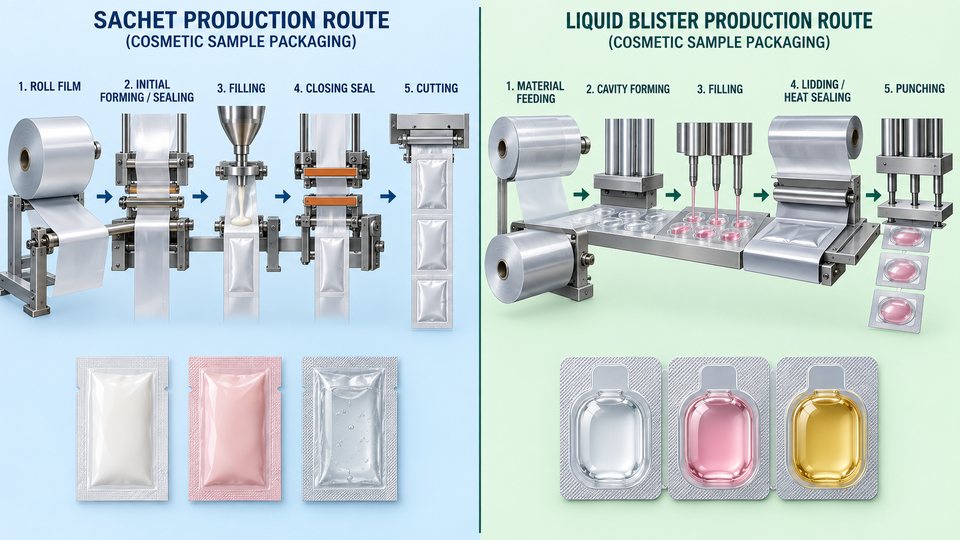
Die Ausrüstung sollte auf das gewählte Verpackungsformat, das Formelverhalten, die Zieldosierung, das Verpackungsmaterial, den erforderlichen Ausstoß und die Umrüstanforderungen abgestimmt sein.Ein Sachet, ein Flüssigkeitsblister, eine Minitube oder eine Miniflasche können eine ähnliche Kosmetikformel enthalten, aber jedes Format erfordert eine andere Abfüll- und Verpackungskonfiguration.
Eine Sachet-Verpackungsmaschine oder Stick-Packmaschine kombiniert Folienzufuhr, Formung, Abfüllung, Versiegelung, Schneiden und Auswurf entsprechend der gewählten Verpackungsstruktur.
Für Flüssigkeits-, Serum-, Creme- oder Gelproben muss das Abfüllsystem auf den Produktfluss und die Viskosität abgestimmt sein, während überschüssiges Produkt vom Siegelbereich ferngehalten werden muss. Rückseitensiegel-, Dreiseitensiegel- und Vierseitensiegelformate erfordern zudem unterschiedliche Folienwege und Siegelanordnungen.
Eine Flüssigkeitsblister-Verpackungsmaschine kombiniert Kavitätenformung, Produktabfüllung, Deckelfolienaufbringung und Heißsiegelung, Stanzen sowie Auswurf.
Die Kavitätsabmessungen beeinflussen das Formwerkzeug und das verfügbare Füllvolumen. Das Formelverhalten beeinflusst das Abfüllsystem, während die Form- und Deckelmaterialien die realisierbaren Siegelbedingungen bestimmen.
Für tiefere Kavitäten kann eine sekundäre Formung erforderlich sein. Das Werkzeugdesign wird ebenfalls wichtig, wenn eine Maschine mehrere Kavitätsgrößen oder Probenformate handhaben muss.
Andere Kosmetikprobenformate verwenden behälterspezifische Ausrüstung anstelle von Rollfolien- oder Thermoformsystemen. Die Maschine sollte sich nach dem Behältertyp, der Verschlussmethode, der Zieldosierung und dem Produktverhalten richten.
|
Probenformat |
Typische Ausrüstung |
Hauptverwendung |
|
Ampulle |
Ampullenabfüll- und Verschließmaschine |
Serum-, Essenz- und konzentrierte Flüssigkeitsproben |
|
Minitube |
Tubenabfüll- und Verschließmaschine |
Creme-, Lotion- und Gelproben |
|
Miniflasche |
Flaschenabfüll- und Verschließmaschine |
Serum-, Öl-, Toner- und Duftproben |
Die genaue Konfiguration für Abfüllung, Verschluss und Umrüstung hängt vom gewählten Behältersystem ab.
Nach der Primärverpackung können Kennzeichnungssysteme, Förderbänder oder Transfersysteme, Inspektionsgeräte und Kartoniermaschinen je nach Fertigpackung und Linienlayout hinzugefügt werden. Sachet-Kartoniermaschinen und Blister-Kartoniermaschinen können die Sekundärverpackung automatisieren, wenn Probenpackungen in Kartons geladen werden müssen. Bei behälterbasierten Proben können bei Bedarf auch Etikettiergeräte hinzugefügt werden.
Ein Abfüllsystem ist ein Dosier-Modul, das in verschiedene Verpackungsmaschinen integriert werden kann, sofern die Maschinenarchitektur und das Design der produktberührenden Teile dies unterstützen. Die Kosmetikabfüllmaschine oder das Flüssigkeitsabfüllsystem sollte daher eher nach Produktverhalten, Zieldosierung, Reinigungsanforderungen und erforderlicher Genauigkeit als allein nach dem Produktnamen ausgewählt werden.
Peristaltische Abfüllsysteme können für gut fließende Flüssigkeiten geeignet sein, Kolbenabfüllsysteme sind praktisch für viskosere Produkte und Keramikpumpen-Abfüllsysteme können verwendet werden, wenn eine höhere Dosierpräzision erforderlich ist. Diese Abfüllprinzipien können auf verschiedene Verpackungsmaschinen angewendet werden, wenn das Anlagendesign sie unterstützt. Eine temperaturgeregelte Produktzuführung kann ebenfalls in Betracht gezogen werden, wenn sich die Viskosität mit der Temperatur signifikant ändert.
Ein Produktionsversuch sollte bestätigen, dass Formel, Verpackungsmaterial, Abfüllsystem, Siegelprozess, Werkzeuge und der erforderliche Ausstoß unter realistischen Betriebsbedingungen zusammenarbeiten.
|
Zu bestätigender Input |
Was er bestimmt |
|
Rezepturverhalten |
Produktzuführungs- und Abfüllprinzip |
|
Zieldosierung |
Dosierbereich |
|
Verpackungsformat |
Maschinenarchitektur |
|
Verpackungsmaterial |
Form- und Siegelkompatibilität |
|
Erforderlicher Ausstoß |
Praktische Produktionskapazität |
|
Anzahl der SKUs |
Anforderungen an die Umrüstung |
|
Reinigungsmethode |
Design und Verfahren für produktberührende Teile |
Der Test sollte die Füllwiederholgenauigkeit, die Sauberkeit der Siegelzone, die Siegel- oder Verschlussleistung, das Öffnen der Verpackung, die Passgenauigkeit der Werkzeuge, den praktischen Ausstoß und die Umrüstung unter Verwendung der tatsächlichen Rezeptur und des vorgesehenen Verpackungsmaterials überprüfen.
Rich Packing bietet Flüssigkeitsabfülllösungen für Sachet-Verpackungsanlagen, Flüssigkeits-Blisterverpackungssysteme und andere kosmetische Verpackungssysteme. Die Maschinenkonfiguration kann auf die Rezeptur, die Zieldosierung, die Verpackungsstruktur, die Siegelmethode und den erforderlichen Ausstoß abgestimmt werden.
Compliance-Hinweis
Compliance-Anforderungen unterstützen das Produktionssystem, bestimmen jedoch nicht, ob ein Sachet, ein Blister oder ein anderes Format die beste Wahl ist. ISO 22716:2007 bietet GMP-Leitlinien für die Produktion, Kontrolle, Lagerung und den Versand von Kosmetika, während ISO 22715:2006 die Verpackung und Kennzeichnung von Kosmetika abdeckt. Für Produkte, die in den Vereinigten Staaten vermarktet werden, sollten auch die geltenden FDA-Anforderungen zur Kennzeichnung von Kosmetika sowie die MoCRA-Verpflichtungen zur Registrierung von Einrichtungen und zur Produktauflistung geprüft werden.
Es gibt kein universell bestes Format. Sachets eignen sich für kompakte, flexible Proben, Blister bieten definierte Kavitäten, und Ampullen, Tuben oder Miniflaschen bieten behälterbasierte Alternativen. Rezeptur, Dosierung, Verwendungszweck, Materialanforderungen und Produktionsweg sollten über das Format entscheiden.
Für Seren können Sachets, Blister, Ampullen oder Miniflaschen verwendet werden. Vergleichen Sie Zieldosierung, Materialkompatibilität, Barriereanforderungen, Öffnungsmethode, Anzahl der Anwendungen, Produktionsvolumen und verfügbare Abfülltechnologie.
Ja. Cremes, Gele und Pasten können in Sachets verpackt werden, wenn das Abfüllsystem das Produkt konsistent verarbeitet und überschüssiges Material vom Siegelbereich fernhält.
Ja. Das Abfüllsystem, die Kavität, das Formmaterial, das Deckelmaterial und der Siegelprozess müssen auf die tatsächliche Rezeptur abgestimmt sein.
Ein Sachet ist im Allgemeinen robuster für den flachen Versand, die Druckfläche und die Effizienz der Rollenfolie. Ein Blister ist besser geeignet, wenn eine definierte Kavität einen funktionalen oder präsentationsbezogenen Vorteil bietet, der zusätzliche Werkzeuge rechtfertigt.
Die Verpackungsstruktur und die notwendigen ersten Siegelungen werden vor dem Befüllen erstellt. Das Produkt wird in den vorbereiteten Verpackungsabschnitt dosiert, gefolgt von der Versiegelung, dem Schneiden und dem Auswurf. Der genaue Folienverlauf hängt vom Sachet-Format ab.
Flüssigkeitsblister durchlaufen typischerweise die Schritte Formen, Befüllen, Deckeln und Heißsiegeln, Stanzen und Auswerfen. Kavitätsgeometrie, Abfüllkonfiguration, Materialien und Werkzeuge werden basierend auf der Rezeptur und der fertigen Packung ausgewählt.
Sachets können Kunststofffolien, aluminiumhaltige Laminate, papierhaltige Strukturen und andere mehrschichtige Materialien verwenden, die für Barriere-, Siegel-, Druck-, mechanische und produktberührende Anforderungen ausgewählt wurden.
Beginnen Sie mit der tatsächlichen Rezeptur und der Zieldosierung. Bewerten Sie Fließverhalten, Viskosität, Temperaturempfindlichkeit, erforderliche Präzision, Abreißverhalten, Reinigung und Ausstoß und bestätigen Sie das Abfüllsystem anschließend durch einen Produktionsversuch.
Testen Sie die Wiederholgenauigkeit der Abfüllung, die Materialverträglichkeit, die Leistung von Siegelung oder Verschluss, das Öffnungsverhalten, die Passgenauigkeit der Werkzeuge, den Produktionsausstoß und die Umrüstzeiten unter Verwendung der tatsächlichen Rezeptur und des vorgesehenen Verpackungsmaterials.
Fazit
Die richtige Verpackung für Kosmetikproben ist das Format, das auf Rezeptur, Dosierung, Abfüllmethode, Material, Siegel- oder Verschlusssystem und Produktionsbedingungen abgestimmt ist.
Sachets sind effizient für flexible Proben, wenn Folie, Abfüllung und Siegelung korrekt aufeinander abgestimmt sind. Flüssigkeitsblister bieten einen definierten Hohlraum, bringen jedoch auch Abhängigkeiten bei Formgebung, Werkzeugen und Siegelung mit sich. Behälterbasierte Formate sollten erst ausgewählt werden, wenn ihre Anforderungen an Dosierung und Anwendung geklärt sind.
Referenzen
ISO 22715:2006 — Kosmetika — Verpackung und Kennzeichnung.

29+ years in pharmaceutical machinery, covering capsule filling, tablet pressing, blister packaging, tablet and capsule counting, cartoning, GMP production, and overseas machine service.

Email : manager@richpacking.cn
Building D, No. 226, Beishan Qiaotou Street, Haizhu District, Guangzhou City, Guangdong Province, China


 IPv6-Netzwerk unterstützt